
Published
As an Amazon Associate, I earn from qualifying purchases. This post contains affiliate links. If you purchase through these links, I earn a small commission at no extra cost to you. I only recommend products I personally believe in and that align with the AltHealth365 mission of natural, honest wellness.
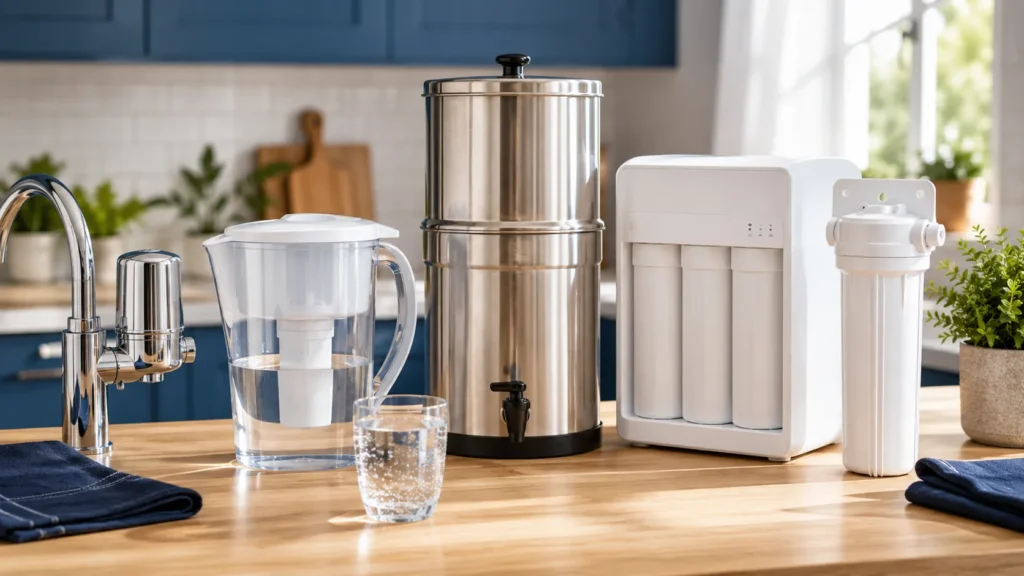
My picks for the best water filters 2026 has to offer are the Brita 10-Cup pitcher for budget taste, the ZeroWater 12-Cup for serious pitcher filtration, the PUR PLUS faucet mount, the Waterdrop 10UA under-sink system, the ProOne Big+ gravity filter for no-plumbing households, and the AquaTru Classic countertop reverse osmosis purifier for the deepest clean. Match the pick to your budget and your sink.
Let’s be honest. Hydration is the most boring habit in all of wellness. Nobody brags about drinking water. There’s no before and after photo for it. And that’s exactly why most of us skip it.
But here’s the thing I learned the hard way: water is the one habit that makes every other habit work better. Your energy, your digestion, your workouts, even how hungry you feel. It all runs on water.
When I was losing my weight, I made one simple rule that changed everything: zero-calorie drinks only. Water, herbal tea, and coffee. That’s it. No soda, no juice, no sugary sports drinks. That one rule gave me so much more flexibility with my food, because I wasn’t drinking my calories anymore.
But here’s the catch. If your tap water tastes like a swimming pool, you won’t drink it. I know I didn’t. The fix for me was a good filter. Once my water actually tasted clean, drinking enough of it stopped being a chore.
So I did the research on what’s actually worth buying. Here are my six picks for the best water filters 2026 has on the shelf, one for every budget and kitchen setup.
My 6 Picks for the Best Water Filters 2026 Has to Offer
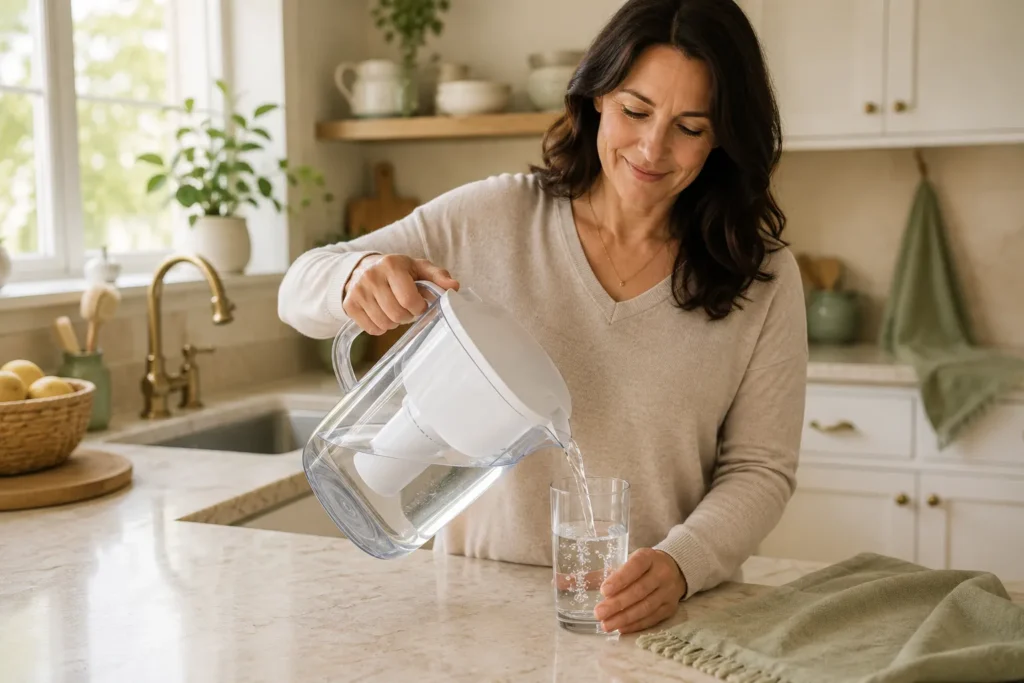
1. Best Budget Pitcher: Brita Large 10-Cup Water Filter Pitcher
This is the classic for a reason. Fill it, stick it in the fridge, and you’ve got cold, clean-tasting water all day. The Standard filter is WQA certified against NSF/ANSI standards to reduce chlorine taste and odor, plus copper, mercury, and zinc.
Filter life is honest and simple: about 40 gallons, which works out to roughly two months for most households. Replacement filters usually run under ten bucks each, so you’re looking at around $40 to $50 a year.
One limitation: the Standard filter is built for taste, not heavy lifting. If lead reduction matters to you, you’ll want Brita’s Elite filter or one of the picks below.
Get the Brita 10-Cup pitcher on Amazon
2. Best Pitcher for Serious Filtration: ZeroWater 12-Cup Ready-Pour
If you want a pitcher that goes way beyond taste, this is the one. ZeroWater uses a 5-stage filter that pulls out nearly all dissolved solids, and it even comes with a little meter so you can test your water yourself. My inner science nerd loves that part.
It’s IAPMO certified against NSF/ANSI standards 42 and 53 to reduce lead, chromium, and PFOA/PFOS, the so-called forever chemicals you keep hearing about.
One limitation: because it filters so much, the filters work hard and don’t last long, especially with hard water. Some homes get 40 gallons per filter, some get 15. At $15 to $20 a filter, the cost adds up faster than a Brita.
Get the ZeroWater 12-Cup on Amazon
3. Best Faucet Mount: PUR PLUS Faucet Mount Water Filtration System (PFM400H)
No pitcher to refill, no tank to wait on. This one clicks right onto your kitchen faucet, and you flip a switch when you want filtered water. PUR PLUS filters are NSF certified to reduce lead plus dozens of other contaminants, which is impressive for something this affordable.
Each filter handles about 100 gallons, roughly three months of normal use. A little light on the unit tells you when it’s time to swap.
One limitation: it won’t fit pull-down or sprayer-style faucets, so check your sink before you order. It can also slow your water flow a bit while filtering.
Get the PUR PLUS faucet mount on Amazon
4. Best Under-Sink Filter: Waterdrop 10UA Under Sink Water Filter System
This is what I’d call the set-it-and-forget-it option. It tucks under your sink, connects to your cold water line, and filters everything that comes out of your main faucet. Installation took reviewers about three minutes, no plumber needed.
The numbers are the big win here: one filter lasts up to 8,000 gallons or a full year. That’s a whole year of filtered water for a family without touching it. It’s NSF/ANSI 42 certified for chlorine taste and odor, and Waterdrop tests it against lead and PFAS reduction too, though the official certification covers the taste and odor standard.
One limitation: it improves taste and reduces common contaminants, but it’s not a reverse osmosis system. If you want the deepest clean possible, look at my last pick.
Get the Waterdrop 10UA on Amazon
5. Best Countertop Gravity Filter: ProOne Big+ Gravity Water Filter System
This one is for big families, well water folks, and anyone who wants serious filtration with no plumbing and no electricity. It’s a 3-gallon stainless steel tank that sits on your counter. You pour water in the top, gravity pulls it down through two ceramic and carbon filters, and clean water waits for you at the spigot. That’s the whole system.
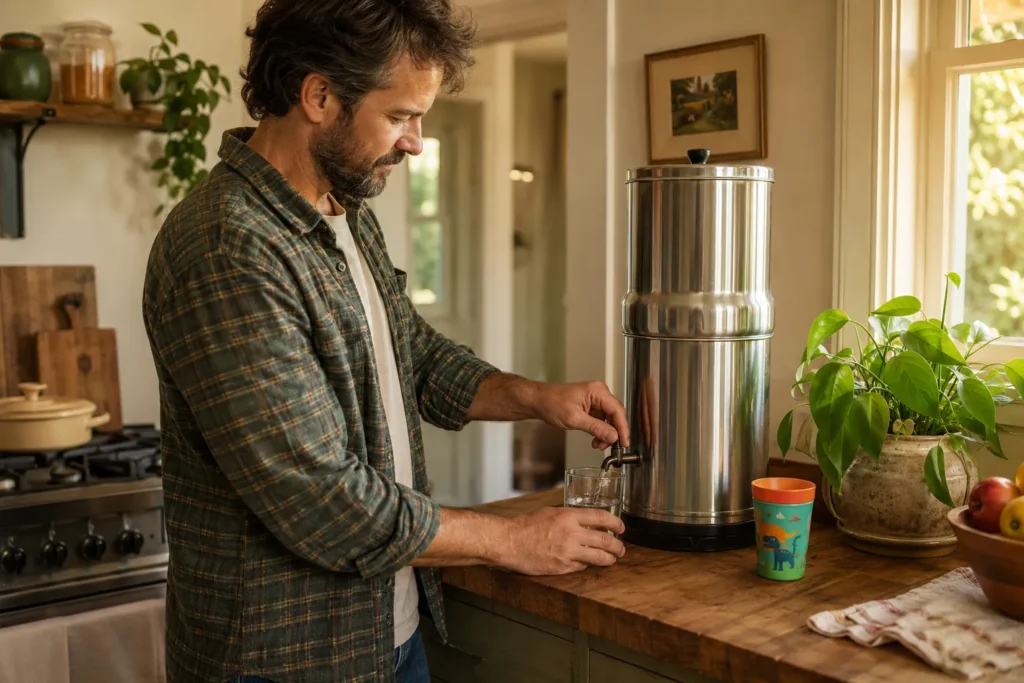
I like it for another reason too: it keeps working when the power doesn’t. If a storm knocks out your electricity for a few days, this thing does not care. That makes it a smart piece of emergency preparedness gear, not just a kitchen appliance.
Now for the honest part. Most gravity filters in this style, including the famous Berkey systems, were never NSF certified. They leaned on their own lab testing, and the Berkey brand has run into real regulatory trouble in recent years, which is exactly why so many people are shopping for alternatives. The ProOne Big+ stands out because it is certified by IAPMO against NSF/ANSI standards 42, 53, and 401, covering chlorine, lead, PFAS, and microplastics. In a category full of big claims, that independent certification is the reason it’s my pick.
Filter life is about six months per set with daily use. A replacement pair usually runs over a hundred dollars, so budget in the neighborhood of $200 a year for a thirsty family. The system itself typically lands in the $200 to $250 range.
One limitation: gravity is slow. It filters less than a gallon per hour, so you fill it and let it work, usually overnight. It also stands close to two feet tall, so make sure you have the counter space.
6. Best Countertop Deep Clean: AquaTru Classic Countertop Reverse Osmosis Purifier
This is the splurge, and it’s the one I’d pick for a family that wants near-purified water without cutting into a single pipe. It sits on your counter, plugs into the wall, and runs 4-stage reverse osmosis. No plumbing, no installation.
AquaTru is certified against NSF/ANSI standards 42, 53, 58, 401, and P473 to reduce dozens of contaminants, including lead, fluoride, PFAS, and microplastics. That’s about as thorough as home filtration gets.
Filter life is solid too. The filters last from six months to two years depending on the stage, and yearly filter costs land around $100 to $130.
One limitation: the price. It typically runs in the $400+ range, and it takes up real counter space. Reverse osmosis also strips out minerals along with the bad stuff, which is worth knowing.
Get the AquaTru Classic on Amazon
What Do Those Water Filter Certifications Actually Mean?
Let’s break it down, because filter companies love throwing numbers at you.
NSF/ANSI 42 means the filter is certified to improve taste and smell, mostly by reducing chlorine. This is the basic, feel-good standard.
NSF/ANSI 53 means the filter is certified to reduce specific health-related contaminants, like lead. This is the one to look for if water quality is your real concern. You can read how these ratings work straight from the certifying body at NSF’s water filter ratings guide.
NSF/ANSI 58 covers reverse osmosis systems, and 401 covers newer contaminants like trace pharmaceuticals.
And one honest note: for most Americans, tap water already meets federal safety standards. You don’t need to panic about your faucet. A filter is about making your water taste better and adding an extra layer of care, the same way you’d choose fresh vegetables over canned. If you’re curious what’s in your local water, your utility publishes a free report every year called a Consumer Confidence Report. Read that first, then match the filter to what you find.
Why Is Clean Water Step One?
Here’s how I think about it. Clean water is the foundation, and everything else builds on top of it. Your supplements absorb better when you’re hydrated, and your gut does its best work when it’s not running dry.
If you’re ready for step two, grab my free 7-Day Supplement Starter Guide or browse my gut health lineup. Simple, honest support that pairs perfectly with that big glass of clean water.
Fill the pitcher. Set it in the fridge. Make it easy to do the boring thing, and the boring thing will take care of you. That is the whole secret to getting your money’s worth from the best water filters 2026 brings to the table.
These statements have not been evaluated by the FDA. This product is not intended to diagnose, treat, cure, or prevent any disease.
Frequently Asked Questions
How often do I replace a filter cartridge?
It depends on the system. Pitcher filters like the Brita run about two months, faucet mounts about three months, and the Waterdrop under-sink lasts up to a year. Most units have an indicator light or sticker, and a simple calendar reminder covers the rest.
Do I need a water filter if my tap water is already safe?
For most Americans, tap water meets federal safety standards, so a filter is mainly about better taste and an extra layer of care. Pull up your utility’s free Consumer Confidence Report first, then match the filter to what you actually find.
Which water filter removes the most contaminants?
Reverse osmosis is the deepest clean you can get at home, and the AquaTru Classic is my countertop pick for it. It is certified against five NSF/ANSI standards to reduce dozens of contaminants, including lead, PFAS, and microplastics.
Are pitcher filters good enough for lead?
The basic Brita Standard filter is built for taste, not lead. The ZeroWater pitcher is certified to reduce lead, so if lead is your concern, look for a filter certified to NSF/ANSI 53 for lead specifically.
Does reverse osmosis remove healthy minerals too?
Yes, reverse osmosis strips minerals out along with the bad stuff. That is not a problem if you eat a decent diet, but some people add a mineral drop or choose a remineralizing option to bring the taste back.
Do gravity water filters need electricity or plumbing?
No, and that is the whole appeal. You pour water in the top chamber and gravity pulls it through the filters, with no power cord, no pipes, and no installation. That is why systems like the ProOne Big+ are popular with well water homes, big families, and anyone building an emergency preparedness setup.
If this helped you, share it with someone who needs it, or shoot me a message and let’s talk!
