

Published · Updated
Magnesium glycinate vs citrate vs oxide, which one should you actually take? Short answer: if your goal is sleep, recovery, and staying regular without the surprise bathroom trips, magnesium glycinate is usually the form worth reaching for. Citrate and oxide have their place, but they are not the same, and the differences matter more than most labels let on. Let me break it down.
Why Does the Form Matter as Much as the Amount?
Here is the thing nobody tells you when you grab a bottle off the shelf. The number on the front, 400mg, 500mg, whatever it says, is only part of the story. What actually counts is how much of that magnesium your body can absorb and use, and how your stomach feels while it does. That comes down to the form.
Magnesium on its own is a mineral your body cannot just swallow as-is, so it gets bound to something else to help carry it in. What it is bound to changes everything: how well it absorbs, how gentle it is, and what it is best used for. Same mineral, very different experiences. That is really the whole magnesium glycinate vs citrate vs oxide question in a nutshell.
Magnesium Glycinate: The Gentle One I Take at Night
Magnesium glycinate is magnesium bound to glycine, a calming amino acid. This is the form I take, most evenings, and the one I reach for first when someone asks me where to start.
It has a reputation for being well absorbed and easy on the stomach, which is exactly why it tends to show up in evening and recovery routines. You are not fighting an upset stomach right before bed, and your body can actually put it to use.
If I skip magnesium glycinate for a few days, I feel it. My sleep gets choppy and my muscles feel tighter. That is not a sales pitch, that is just what happens for me.
What glycinate may support:
- Relaxation and a healthy response to everyday stress
- Restful sleep as part of an evening routine
- Muscle comfort and recovery after activity
Best for: sleep, stress, recovery, and anyone who has had their stomach turned by other magnesium forms.
Magnesium Citrate: The Better-Absorbed Workhorse
Magnesium citrate is magnesium bound to citric acid. It absorbs noticeably better than oxide, so on paper it looks great, and for some people it is a solid pick.
The catch is its reputation for a laxative effect, especially at higher amounts. That is not a flaw exactly, it is actually why citrate shows up in some occasional-constipation products. But it makes it a rougher fit for a nightly wind-down routine, because the last thing you want when you are trying to sleep through the night is your gut deciding to wake you up.
Best for: people who tolerate it well and want better absorption than oxide, or who are specifically looking for gentle regularity support. Less ideal as a nightly sleep form.
Magnesium Oxide: Cheap, Common, and Poorly Absorbed
Magnesium oxide is the one you will find in a lot of budget bottles, because it is inexpensive and it packs a high amount of magnesium by weight. The problem is absorption. Your body takes in only a small fraction of it, and a lot of what you swallow passes right through.
This is a big reason you hear people say magnesium “did nothing” for them. Often they were taking oxide, absorbing very little of it, and understandably concluding the whole mineral was useless. It was not the mineral, it was the form.
Best for: honestly, not much when your goal is sleep or recovery. It can still draw water into the gut, so like citrate it sometimes shows up for occasional regularity, but as a daily foundation it is the weakest of the three.
A Quick Side-by-Side: Magnesium Glycinate vs Citrate vs Oxide
Here is the full magnesium glycinate vs citrate vs oxide comparison at a glance, so you can match the form to what you actually need.
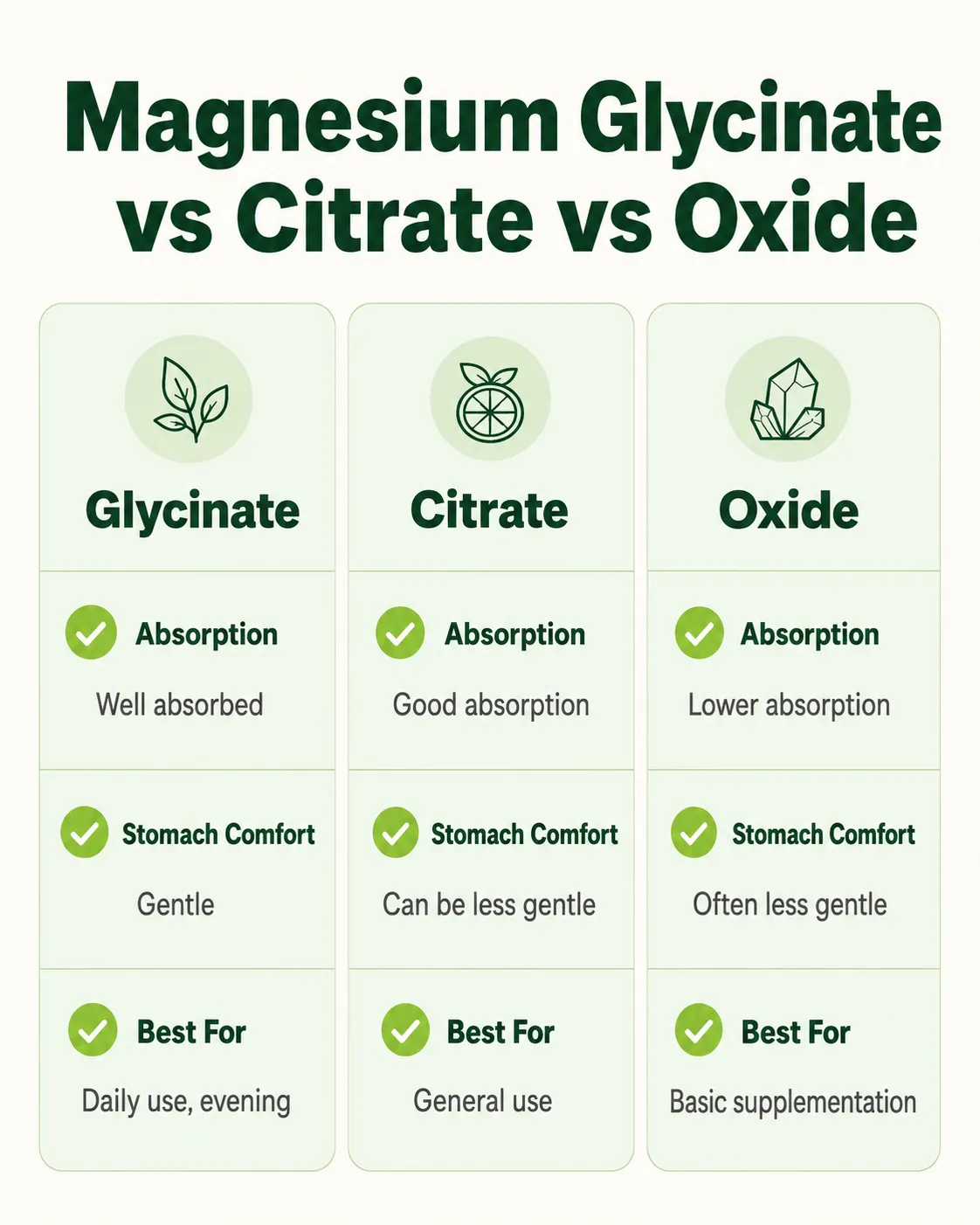
| Glycinate | Citrate | Oxide | |
|---|---|---|---|
| Absorption | Well absorbed | Good absorption | Lower absorption |
| Stomach Comfort | Gentle | Can be less gentle | Often less gentle |
| Best For | Daily use, evening | General use | Basic supplementation |
- Absorption: Glycinate high, Citrate moderate to high, Oxide low.
- Stomach comfort: Glycinate gentle, Citrate can loosen things up, Oxide can loosen things up.
- Best for: Glycinate sleep and recovery, Citrate absorption or regularity, Oxide budget and regularity.
If you remember one line from this whole post, make it this: the best form of magnesium is the one your body actually absorbs and you will actually take every night. For most people chasing better sleep, that is glycinate.
Which One Do I Take, and Why?
When I actually weighed magnesium glycinate vs citrate vs oxide for my own nightstand, the choice was easy. I have talked before about how magnesium glycinate became a quiet MVP in my routine. When it is part of my evenings, I sleep better and recover faster. When I skip it, that low-grade stress creeps back and my sleep gets inconsistent. That pattern, more than anything I read, is why it stuck.
I did not add supplements to shortcut the work. I added them to support it. The clean eating and the movement did the heavy lifting when I was rebuilding my habits. Magnesium glycinate just helped me keep showing up, night after night.
What the Research Actually Says About Magnesium Glycinate
I would rather point you to the research than ask you to take my word for it, so here is where the science sits right now.
A randomized, placebo-controlled trial published in Nature and Science of Sleep looked specifically at magnesium bisglycinate, the glycinate form, in healthy adults who reported poor sleep. It found improvements in sleep measures compared to a placebo. Read the study.
An earlier systematic review and meta-analysis found that older adults fell asleep faster, roughly 17 minutes faster on average, when taking magnesium versus a placebo. The researchers were honest that the studies were small and the overall quality was low, so they called it supportive rather than settled. Read the review.
A few honest takeaways:
- The evidence looks most consistent for people who are already low in magnesium, which a lot of us over 40 are.
- Glycinate keeps showing up in this research partly because it is well absorbed and gentle.
- This is still a developing area. Magnesium may support relaxation and sleep, but it is not a cure or a guarantee, and the studies say so too.
That honesty is the whole point. Real research, real limits, and a form that keeps earning its place.
Product Spotlight: Magnesium Glycinate 275mg

If you have weighed magnesium glycinate vs citrate vs oxide and landed on glycinate, this is the one I actually stock. Our Magnesium Glycinate 275mg delivers 275mg of elemental magnesium per 3-capsule serving, in a highly absorbable, stomach-gentle form. Non-GMO, third-party lab tested, GMP certified, made in the USA, in vegetarian capsules.
- May support relaxation and a healthy response to everyday stress
- May support restful sleep as part of an evening routine
- May support muscle comfort and recovery
- May support healthy bone density
90 capsules per bottle, a full 30-day supply at 3 capsules daily. $22.99.
Shop Magnesium Glycinate 275mg
Want the exact evening habits I pair it with? Grab my free Evening Wind-Down Routine, a one-page card with the timing and steps I use, plus 30% off your first order.
FAQs: Magnesium Glycinate vs Citrate vs Oxide
Which form of magnesium is best for sleep?
Magnesium glycinate is the form most associated with sleep and evening routines, because it is well absorbed and gentle on the stomach.
Why does magnesium oxide get a bad reputation?
Oxide is poorly absorbed, so a lot of it passes through unused. That is often why people feel like magnesium “does nothing” for them.
Is magnesium citrate bad for you?
Not at all. It absorbs well, but it can have a laxative effect at higher amounts, which makes it a rougher fit for a nightly sleep routine.
How much magnesium should I take?
Our Magnesium Glycinate is dosed at 275mg of elemental magnesium per 3-capsule serving, taken in the evening. Your needs may differ, so check with your doctor if you take medication or manage a health condition.
Can I switch from oxide to glycinate?
Many people do, especially if oxide upset their stomach or did not seem to help. Talk to your doctor if you have any health conditions before changing supplements.
Final Thoughts
Same mineral, three very different results. That is the short version of magnesium glycinate vs citrate vs oxide. If your goal is better sleep and easier recovery, start with glycinate, take it consistently in the evening, and give it a few weeks. Pay attention to what you actually notice.
If you want to see what else I keep in my own cabinet, take a look around the site.
These statements have not been evaluated by the Food and Drug Administration. This product is not intended to diagnose, treat, cure, or prevent any disease.
