

Published · Updated
Short answer: If you are considering magnesium glycinate for sleep, start with the serving label and your evening habits. Our label lists 275mg of elemental magnesium per three capsules. That describes the product, not a dose everyone needs. Below, I explain my own routine, the research and the questions to discuss with your healthcare provider.
Let’s Break It Down
If I skip magnesium glycinate for a few days, I feel it. My sleep gets choppy, and my muscles feel tighter.
That’s not a sales pitch. That’s just what happens. Magnesium glycinate for sleep became part of my nightly routine years ago, and “how much magnesium glycinate for sleep do I actually need” is the question I get asked more than any other, so let’s actually answer it instead of dancing around it.
How Much Magnesium Glycinate Do You Actually Need?
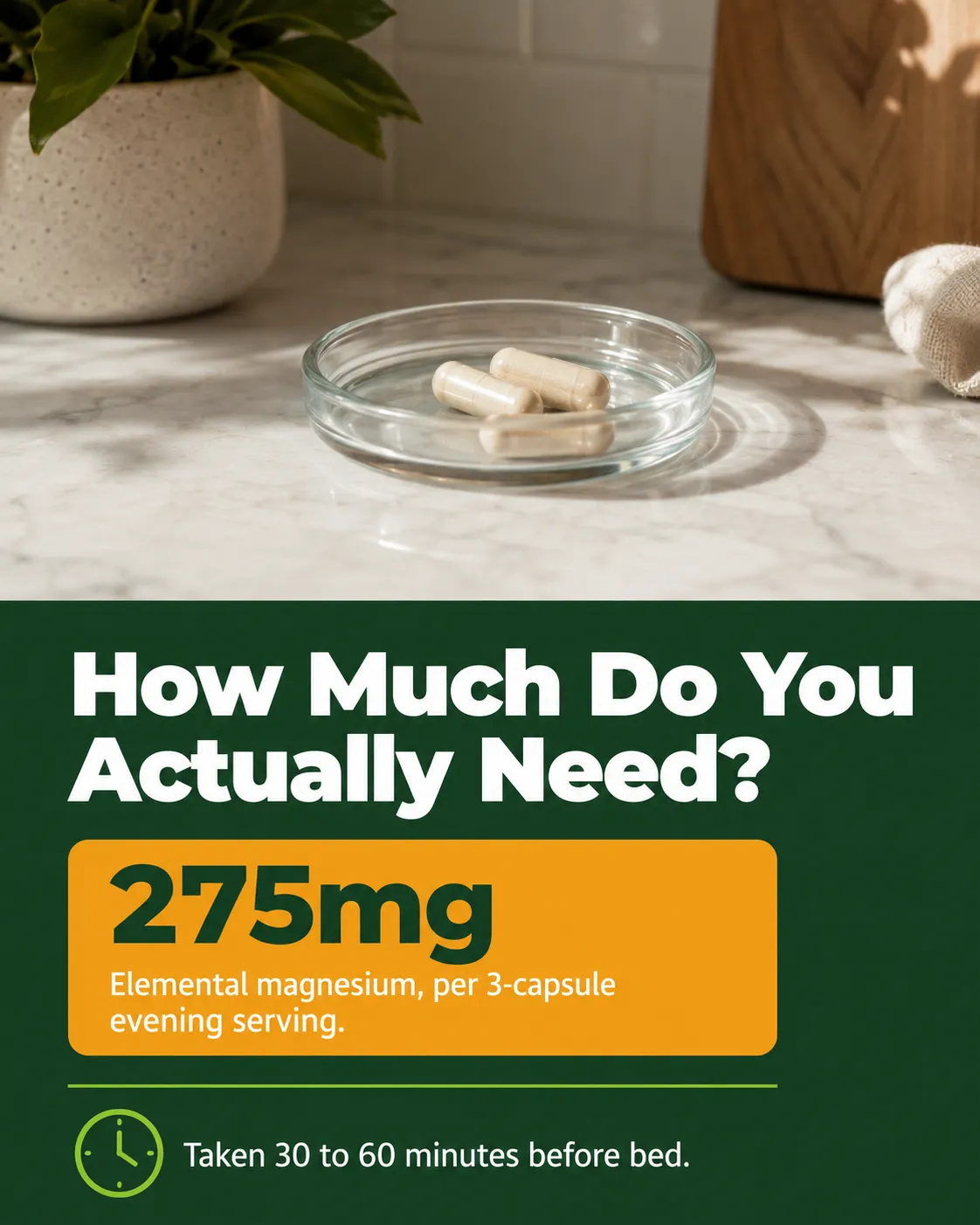
When it comes to magnesium glycinate for sleep, there’s no single number that works for every body, and I’m not going to pretend there is. What I can tell you is what a full serving of our Magnesium Glycinate looks like and why it’s built that way: 275mg of elemental magnesium per 3-capsule serving, taken in the evening. That’s the number on our label, and it’s the number I take myself, most nights, roughly 30 to 60 minutes before I turn in.
A few things that matter more than chasing a bigger number:
- Consistency beats dosage. Taking a moderate amount every night tends to matter more than taking a large amount occasionally.
- Timing matters. Evening, ahead of bed, gives your body a window to use it before you’re actually trying to fall asleep.
- More isn’t automatically better. Magnesium is one of those supplements where going past what your body needs mostly just means an unplanned trip to the bathroom, not a better night’s sleep.
If you’re taking any medication or managing a health condition, talk to your doctor before starting any new supplement, magnesium included.
Magnesium Glycinate vs Other Forms (Why the Form Matters as Much as the Amount)
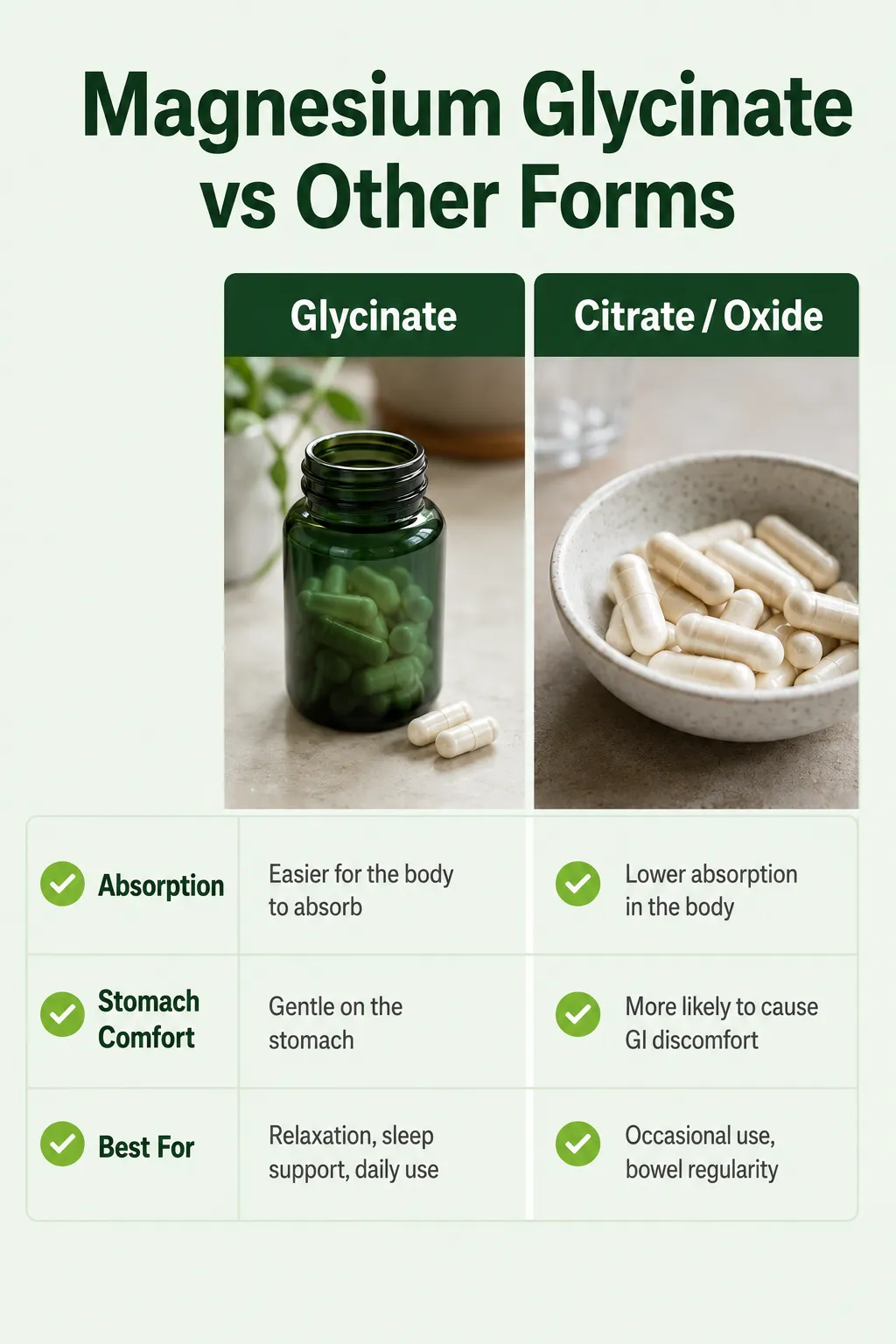
Not all magnesium is built the same, and the form it comes in changes how much of it your body can actually use, and how your stomach handles it.
- Magnesium glycinate is magnesium bound to the amino acid glycine. It’s known for being gentle on the stomach and well absorbed, which is part of why it’s the form most associated with evening and sleep routines.
- Magnesium oxide is common and cheap, but it’s poorly absorbed. A lot of what you take may pass through unused, which is part of why some people say magnesium “doesn’t do anything” for them.
- Magnesium citrate absorbs better than oxide, but it has a reputation for a laxative effect at higher amounts, which makes it a rougher fit for a nightly routine.
The form and the elemental amount are different label details. My glycinate, citrate and oxide comparison explains the form question. Here, I am focusing on the serving amount.
Want the exact routine I use? Grab my free 7-Night Better Sleep Checklist. Seven simple habits, one week, plus a 30% off code for your first order.
What Two Years of Taking Magnesium Glycinate for Sleep Has Actually Looked Like
When it’s part of my routine, I sleep better and recover faster. It’s a quiet MVP in my supplement lineup.
Here’s what that actually looks like day to day. When I’m consistent with it, I notice less everyday stress and less of that low-grade anxious edge that used to follow me around. After a hard workout, my muscles recover faster and I’m not as sore the next day. When I skip it for a few days, that flips: stress creeps back up, muscle recovery slows down, and my sleep gets inconsistent, some nights fine, some nights tossing and turning for no clear reason. That pattern, more than anything I’ve read, is the reason it’s stayed in my routine.
I didn’t take supplements to shortcut the work. I took them to support it. Things like magnesium glycinate, vitamin D, and our B-12 drops helped me stay consistent, especially in the stretch where I was rebuilding basically every habit I had. The diet and the movement did the heavy lifting. The stack helped me keep showing up for it.
These days it’s simple: three capsules, most evenings, roughly half an hour to an hour before bed. I don’t overthink it, and I don’t take extra on a hard day expecting a bigger payoff. Consistency is the whole game.
Why I Also Pair It With Magnesium Taurate
Magnesium glycinate isn’t the only form in my routine. I also take magnesium taurate alongside it, and I added it after digging into the research on magnesium and blood pressure specifically. Research on magnesium taurate, so far mostly animal studies, points to it as a form worth looking at for anyone interested in supporting blood pressure that’s already in a normal range. Human research on this specific form is still limited, so I treat it the way I treat everything else here: one piece of the routine, not a fix.
Magnesium taurate isn’t part of our current product lineup, so I won’t link you to something we sell. I’d rather be straight with you about what’s actually in my own routine than only mention what’s on our shelf. If you’re managing blood pressure or take medication for it, talk to your doctor before adding anything new, magnesium taurate included.
What the Research Actually Says About Magnesium Glycinate and Sleep
I do not want you taking my word alone on dosage, so here is where the research actually sits.
A randomized, placebo-controlled trial published in Nature and Science of Sleep tested magnesium bisglycinate, the glycinate form, in healthy adults reporting poor sleep, and found improvements in sleep measures compared to a placebo.
An earlier systematic review and meta-analysis found that older adults fell asleep roughly 17 minutes faster on average with magnesium versus a placebo, though the authors were upfront that the studies were small and lower quality.
A few honest takeaways, specific to the dosage question:
- The doses studied land in a similar range to what is on our label, not a dramatically higher number.
- The benefit looks most consistent in people who are already running low on magnesium, which is common as we age.
- This is a developing area of research. Magnesium may support relaxation and sleep, but it is not a guaranteed fix, and good researchers say so plainly.
That matches what I said above: consistency at a reasonable dose beats chasing a bigger number.
Product Spotlight: Magnesium Glycinate 275mg
Our Magnesium Glycinate 275mg delivers 275mg of elemental magnesium per 3-capsule serving, in a highly absorbable, stomach-gentle form. Non-GMO, third-party lab tested, GMP certified, made in the USA, in vegetarian capsules.
- May support relaxation and a healthy response to everyday stress
- May support restful sleep as part of an evening routine
- May support muscle comfort and recovery
- May support healthy bone density
90 capsules per bottle, a full 30-day supply at 3 capsules daily. $22.99.
Want to see how this fits into a full daily lineup? Read how I stack my supplements for energy, sleep, and focus, or grab my free 7-Night Better Sleep Checklist for the exact habits I use, plus a tracker and 30% off your first order.
FAQs About Magnesium Glycinate for Sleep
How much magnesium glycinate for sleep do you actually need?
Our Magnesium Glycinate is dosed at 275mg of elemental magnesium per 3-capsule serving, taken in the evening. That's the amount I take myself, most nights. Your own needs may differ, so check with your doctor if you're unsure.
When should I take magnesium glycinate?
Most people, myself included, take it in the evening, roughly 30 to 60 minutes before bed.
Will taking more help me sleep better?
Not necessarily. Past a certain point, extra magnesium mostly just passes through you rather than doing more for sleep. Consistency matters more than the size of the dose.
Why glycinate instead of another form?
Magnesium glycinate is known for being gentle on the stomach and well absorbed, which is part of why it's the form most people reach for at night, compared to forms like oxide or citrate.
Can I take magnesium glycinate with my other supplements?
Generally, yes. It's a common piece of an evening wind-down or recovery stack. If you take medication or have a health condition, check with your doctor first.
Do you take anything else alongside magnesium glycinate?
Yes, I also take magnesium taurate, mainly because of the research behind that form and blood pressure. It's not one of our products, just something in my own personal routine. Talk to your doctor before adding it to yours, especially if you're on blood pressure medication.
Final Thoughts
The number on the label matters less than actually taking it the same way, most nights.
For magnesium glycinate for sleep dosage, separate the amount on a product label from your own needs. Follow the current directions and ask your healthcare provider if you are unsure.
Compare my Magnesium Glycinate label and bottle options.
These statements have not been evaluated by the Food and Drug Administration. This product is not intended to diagnose, treat, cure, or prevent any disease.
