

Published · Updated
If you have started running into sleep problems in your 40s, you are not imagining it and you are not broken. Something real changes in this decade, and once you understand it, the fix stops feeling like a mystery. Let me break it down.
I Thought I Just Wasn’t a Good Sleeper
For the longest time I figured some people sleep well and some people don’t, and I had landed in the wrong group. Waking up at 2am. Mind racing the second my head hit the pillow. Waking up tired even after a full night in bed.
Turns out it was not a character flaw. My sleep was changing the way most people’s do in their 40s, and once I stopped blaming myself and started working with it, things got a lot better.
What Causes Sleep Problems in Your 40s?
Here is the plain-English version of what is going on under the hood, and why sleep problems in your 40s are so common.
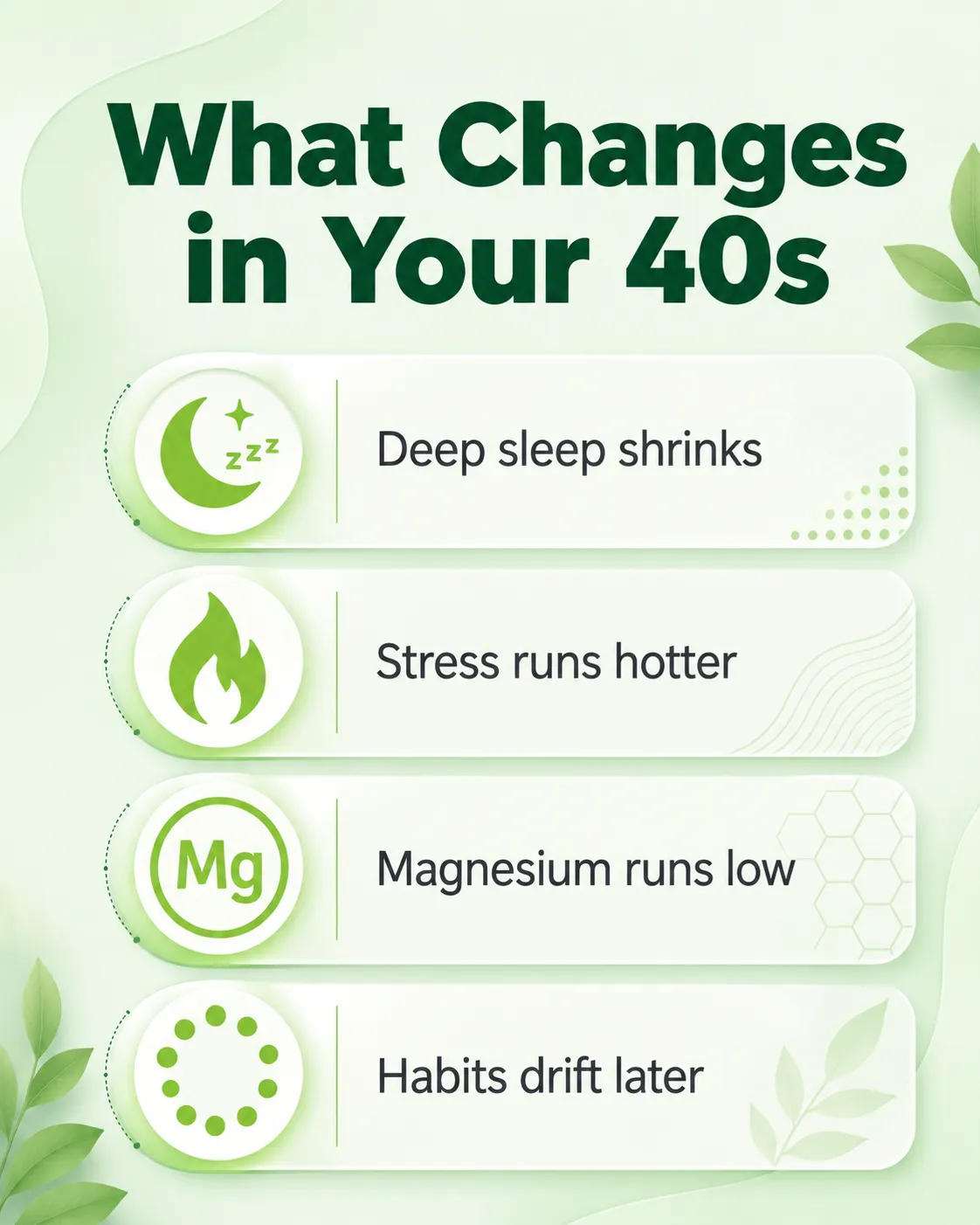
Your deep sleep shrinks. The deep, restorative stages of sleep naturally get shorter with age. You can spend eight hours in bed and still get less of the good stuff than you did at 25.
Your stress system runs hotter. Work, kids, aging parents, money, all of it tends to peak in this decade. A revved-up stress response makes it harder to downshift at night, which is why your brain picks 2am to replay every awkward thing you have ever done.
Your minerals run low. A lot of people over 40 are running low on magnesium, and magnesium is one of the minerals your nervous system leans on to relax. When it is short, switching into rest mode is genuinely harder. It is not a willpower problem, it is a mineral problem.
Your habits drift. Later caffeine, more evening screens, a nightcap that fragments your sleep, dinner too close to bed. None of these are dramatic on their own, but they stack up right when your sleep is already more fragile.
The good news in all of that: most of it is workable. You are not stuck with the sleep you have.
What Actually Helped Me
I am not going to hand you a 30-step routine, because I would not follow it either. Here is what actually moved the needle for me, in rough order of impact.
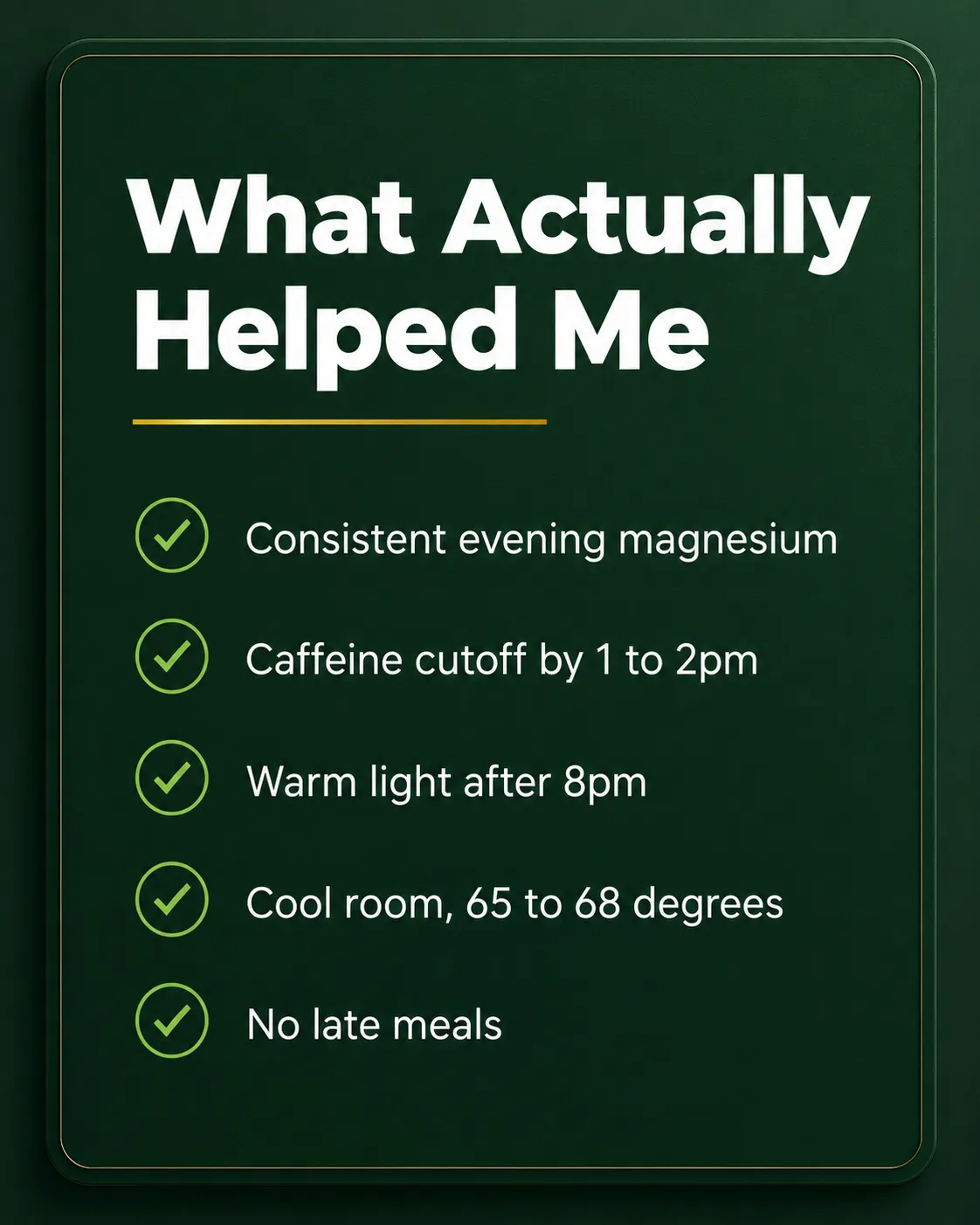
I got my magnesium consistent. Once I started taking magnesium glycinate in the evening, most nights, the 2am wake-ups eased off and the racing thoughts quieted down. When I skip it for a few days, I feel it, choppy sleep and tighter muscles. Consistency mattered more than anything.
I moved my caffeine cutoff earlier. Coffee after early afternoon can still be working in your system at bedtime. I stop by around 1 to 2pm now.
I dimmed the evening. Bright overhead lights and late screens tell your brain to stay alert. Warm lighting after 8pm and no screens for the last 20 to 30 minutes made falling asleep easier.
I cooled the room down. A cooler bedroom, somewhere in the 65 to 68 degree range for most people, helps your body do what it naturally wants to do at night.
I stopped eating so late. Giving my digestion a couple of hours to wind down before bed took away a surprising amount of the tossing and turning.
None of these are exotic. That is the point. Small, boring, repeatable beats dramatic and unsustainable every single time.
Where Does Magnesium Glycinate Fit?
Magnesium glycinate is magnesium bound to a calming amino acid, and it is known for being well absorbed and gentle on the stomach. That is why it tends to be the form people reach for at night. It became a quiet MVP in my lineup, the kind of thing you do not notice until you stop and your sleep gets choppy again.
What the Research Actually Says About Magnesium and Sleep
I do not want you taking my word alone for this, so here is where the science sits.
A randomized, placebo-controlled trial published in Nature and Science of Sleep tested magnesium bisglycinate, the glycinate form, in healthy adults reporting poor sleep, and found improvements in sleep measures compared to a placebo.
An earlier systematic review and meta-analysis found that older adults fell asleep roughly 17 minutes faster on average with magnesium versus a placebo. The authors were upfront that the studies were small and lower quality, so they treated it as supportive rather than proven.
A few honest takeaways:
- The benefit looks most consistent in people who are already low in magnesium, which is common as we age.
- The glycinate form keeps showing up in this research because it is well absorbed and gentle.
- This is a developing area. Magnesium may support relaxation and sleep, but it is not a cure, and good researchers say so plainly.
I like that honesty. It matches how I actually think about my own routine.
Product Spotlight: Magnesium Glycinate 275mg
Our Magnesium Glycinate 275mg delivers 275mg of elemental magnesium per 3-capsule serving, in a highly absorbable, stomach-gentle form. Non-GMO, third-party lab tested, GMP certified, made in the USA, in vegetarian capsules. It is part of our better sleep lineup.
- May support relaxation and a healthy response to everyday stress
- May support restful sleep as part of an evening routine
- May support muscle comfort and recovery
90 capsules per bottle, a 30-day supply. $22.99.
New to magnesium? Here is how glycinate compares to citrate and oxide.
Want a simple place to start? Grab my free Evening Wind-Down Routine, the one-page card with the exact timing and steps I use, plus 30% off your first order.
Why do I keep waking up at 3am in my 40s?
Deep sleep naturally shortens with age and a busier stress system makes it easier to surface in the early hours. Getting magnesium consistent, cutting caffeine earlier, and dimming the evening all help.
Is it normal for sleep to get worse after 40?
Yes, it is very common. It does not mean anything is wrong with you, and a lot of it responds to simple routine changes.
What is the best supplement for sleep over 40?
Magnesium glycinate is the form most associated with evening and sleep routines because it is well absorbed and gentle. Talk to your doctor before starting anything new.
Does magnesium actually help you sleep?
For me, being consistent with magnesium glycinate quieted the 2am wake-ups and racing thoughts. It may support relaxation and restful sleep as part of an evening routine, though everyone is different.
When should I take magnesium glycinate?
Most people, myself included, take it in the evening, roughly 30 to 60 minutes before bed.
Final Thoughts
Sleep problems in your 40s are normal, and suffering through them is optional. Pick two or three of these, do them consistently for a few weeks, and pay attention to how you feel. Start with the boring stuff. It works.
If this helped you, share it with someone who needs it, or shoot me a message and let’s talk!
These statements have not been evaluated by the Food and Drug Administration. This product is not intended to diagnose, treat, cure, or prevent any disease.
